New model explains lunar magnetism
Posted: Thu, Jan 9, 2003, 8:37 AM ET (1337 GMT)
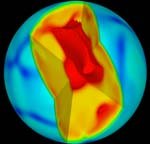 A "burp" of hot rock nearly four billion years ago may explain why the Moon once had a weak magnetic field. In a paper published in Thursday's issue of the journal Nature, planetary scientists at the University of California Berkeley report on a new model of the interior of the Moon. According to the model, the interior of the Moon cooled rapidly after the Moon was formed from the collision of a Mars-sized body with the proto-Earth. The last material to cool in the mantle, a layer of titanium- and thorium-rich rock, fell to the core-mantle boundary where radioactive decay heated it up, forming several superplumes, or "burps" of hot rock. This permitted convective heat flow to take place in the core, powering a dynamo that generated a magnetic field one-fifth as strong as the Earth's that lasted for 300 million years. This new model may explain how the Moon, once thought too small to generate a dynamo, could have a magnetic field that magnetized surface rocks found during Apollo and other lunar missions. The superplumes could also explain the creation of the basalt-rich maria on the near side of the lunar surface.
A "burp" of hot rock nearly four billion years ago may explain why the Moon once had a weak magnetic field. In a paper published in Thursday's issue of the journal Nature, planetary scientists at the University of California Berkeley report on a new model of the interior of the Moon. According to the model, the interior of the Moon cooled rapidly after the Moon was formed from the collision of a Mars-sized body with the proto-Earth. The last material to cool in the mantle, a layer of titanium- and thorium-rich rock, fell to the core-mantle boundary where radioactive decay heated it up, forming several superplumes, or "burps" of hot rock. This permitted convective heat flow to take place in the core, powering a dynamo that generated a magnetic field one-fifth as strong as the Earth's that lasted for 300 million years. This new model may explain how the Moon, once thought too small to generate a dynamo, could have a magnetic field that magnetized surface rocks found during Apollo and other lunar missions. The superplumes could also explain the creation of the basalt-rich maria on the near side of the lunar surface.
Related Links:
| <<previous article | next article>> |
|
news in brief
|
|
|
|
news links
|
|
Monday, September 28
An endangered wild cat faces a new threat: SpaceX’s expansion in Texas
NBCNews.com — 4:43 am ET (0843 GMT) FAA Clears SpaceX For Starship 14 Flight
Aviation Week — 4:41 am ET (0841 GMT) SpaceX sends Starship into orbit
The Economist — 4:40 am ET (0840 GMT) SpaceX prepares to send Starship rocket to orbit for first time
CNBC — 4:40 am ET (0840 GMT) Orbital Shift: India's space sector undergoing biggest transformation
The Economic Times (India) — 4:38 am ET (0838 GMT) |
