Astronomers see light from earliest stars
Posted: Thu, Nov 3, 2005, 7:50 AM ET (1250 GMT)
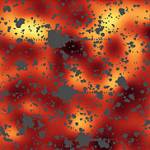 Astronomers announced Wednesday that they have detected light that may eminate from the universe's earliest stars. NASA's Spitzer Space Telescope detected the infrared light from "giant blobs" during extended observations in the direction of the constellation Draco. Astronomers believe the light comes from "Population 3" stars, a hypothesized class of stars not previously detected that were the first to form after the Big Bang. The stars were extremely large and short-lived, shining brightly at ultraviolet wavelengths that have redshifted to infrared bands because of the expansion of the universe. Alternatively, the light may come from hot gas falling into the universe's first black holes.
Astronomers announced Wednesday that they have detected light that may eminate from the universe's earliest stars. NASA's Spitzer Space Telescope detected the infrared light from "giant blobs" during extended observations in the direction of the constellation Draco. Astronomers believe the light comes from "Population 3" stars, a hypothesized class of stars not previously detected that were the first to form after the Big Bang. The stars were extremely large and short-lived, shining brightly at ultraviolet wavelengths that have redshifted to infrared bands because of the expansion of the universe. Alternatively, the light may come from hot gas falling into the universe's first black holes.
Related Links:
| <<previous article | next article>> |
|
news in brief
|
|
NASA releases report on Starliner crewed test flight problems
Posted: Sun, Feb 22 11:45 AM ET (1645 GMT) |
|
news links
|
|
Tuesday, February 24
China's mysterious Shenlong space plane recently launched on its 4th mission. What is it doing up there?
SPACE.com — 6:15 am ET (1115 GMT) Aurora forecast Feb. 24 - Northern lights could remain active tonight as fast solar winds linger
SPACE.com — 6:14 am ET (1114 GMT) Where to see the total lunar eclipse in the early hours of March 3
SPACE.com — 6:14 am ET (1114 GMT) Astronomers Witness Transformation of One of the Largest Stars
Sky & Telescope — 6:13 am ET (1113 GMT) Saturn’s rings may have formed after a huge collision with Titan
New Scientist — 6:10 am ET (1110 GMT) |
