Astronomers discover Sun-like solar system
Posted: Thu, Aug 16, 2001, 11:26 AM ET (1526 GMT)
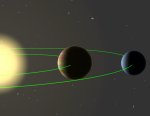 Astronomers have discovered a solar system that is the most similar to our own found to date. Astronomers announced Wednesday the discovery of a second planet orbiting the star 47 Ursae Majoris, a Sun-like star 51 light-years from the Earth in the direction of the Big Dipper. The new planet has a minimum mass three-quarters that of Jupiter in a 7.1-year circular orbit that, if placed in our solar system, would lie between Mars and Jupiter. The planet, discovered by a team that includes veteran planet hunters Geoff Marcy and Paul Butler, joins a larger, inner planet found five years ago by Marcy and Butler. Both planets are unlike most of the over 70 extrasolar planets discovered to date, which either orbit very close to their parent stars or are in highly elliptical orbits, unlike any of the planets in our solar system. Astronomers credit more sensitive instruments and larger sets of data — stretching back more than a decade in the case of 47 Ursae Majoris — for enabling this discovery.
Astronomers have discovered a solar system that is the most similar to our own found to date. Astronomers announced Wednesday the discovery of a second planet orbiting the star 47 Ursae Majoris, a Sun-like star 51 light-years from the Earth in the direction of the Big Dipper. The new planet has a minimum mass three-quarters that of Jupiter in a 7.1-year circular orbit that, if placed in our solar system, would lie between Mars and Jupiter. The planet, discovered by a team that includes veteran planet hunters Geoff Marcy and Paul Butler, joins a larger, inner planet found five years ago by Marcy and Butler. Both planets are unlike most of the over 70 extrasolar planets discovered to date, which either orbit very close to their parent stars or are in highly elliptical orbits, unlike any of the planets in our solar system. Astronomers credit more sensitive instruments and larger sets of data — stretching back more than a decade in the case of 47 Ursae Majoris — for enabling this discovery.| <<previous article | next article>> |
|
news in brief
|
|
|
|
news links
|
|
Friday, September 25
New tests for rendezvous and docking interoperability
ESA — 5:24 am ET (0924 GMT) Poland says Starlink fire was sabotage
POLITICO — 5:23 am ET (0923 GMT) Inside NZ’s little-known role in an international military space operation
Stuff.co.nz — 5:20 am ET (0920 GMT) Iridium Stockholders Approve Acquisition by Rocket Lab
PR Newswire — 5:19 am ET (0919 GMT) SpaceApps Hitches Blue Origin MK1 Lander Ride For Lunar Rover Mission
Aviation Week — 5:17 am ET (0917 GMT) |
