Kepler discovers its first five exoplanets
Posted: Tue, Jan 5, 2010, 5:50 AM ET (1050 GMT)
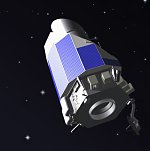 NASA's Kepler spacecraft, a mission designed ultimately to detect Earth-like planets around other stars, has discovered its first five exoplanets, scientists said Monday. The five planets are all "hot Jupiters", ranging in size from Neptune to bigger than Jupiter, and lie close to their parent stars, completing orbits in 3.3 to 4.9 days. All of the planets have high temperatures, with some exceeding the temperature of molten iron. Of particular interest to scientists is one planet, Kepler-7b, whose density is extremely low: approximately the same as styrofoam. Scientists said some kind of heating, from the star or from tidal friction, may be causing the planet to "puff out" and thus decrease its density. The discoveries come from the first six weeks of data collected by the spacecraft since it started science observations in May of last year; the discoveries were confirmed by follow-up observations by groundbased telescopes. Kepler is designed to look for exoplanets by detecting transits, when a planet passes between the star and observer, causing a minute drop in brightness; it simultaneously and continuously observes 150,000 stars in one area of the sky. Scientists hope that with enough data they will be able to detect planets as small as the Earth orbiting in the habitable zone of their stars.
NASA's Kepler spacecraft, a mission designed ultimately to detect Earth-like planets around other stars, has discovered its first five exoplanets, scientists said Monday. The five planets are all "hot Jupiters", ranging in size from Neptune to bigger than Jupiter, and lie close to their parent stars, completing orbits in 3.3 to 4.9 days. All of the planets have high temperatures, with some exceeding the temperature of molten iron. Of particular interest to scientists is one planet, Kepler-7b, whose density is extremely low: approximately the same as styrofoam. Scientists said some kind of heating, from the star or from tidal friction, may be causing the planet to "puff out" and thus decrease its density. The discoveries come from the first six weeks of data collected by the spacecraft since it started science observations in May of last year; the discoveries were confirmed by follow-up observations by groundbased telescopes. Kepler is designed to look for exoplanets by detecting transits, when a planet passes between the star and observer, causing a minute drop in brightness; it simultaneously and continuously observes 150,000 stars in one area of the sky. Scientists hope that with enough data they will be able to detect planets as small as the Earth orbiting in the habitable zone of their stars.
Related Links:
| <<previous article | next article>> |
|
news in brief
|
|
|
|
news links
|
|
Thursday, February 19
More than 150 employees made redundant as rocket manufacturer officially enters administration
Inverness (UK) Courier — 6:40 am ET (1140 GMT) Orbex appoints FRP as administrators, advisory firm says
Global Banking and Finance Review — 6:39 am ET (1139 GMT) More than 150 staff facing axe as Scots manufacturing firm plunges into administration
The Sun — 6:39 am ET (1139 GMT) Scots space rocket company enters administration
STV — 6:38 am ET (1138 GMT) FRP Advisory administrators appointed to Scottish space launch company Orbex
Scottish Financial News — 6:38 am ET (1138 GMT) |
