Hubble sees faintest stars in cluster
Posted: Fri, Aug 18, 2006, 8:13 AM ET (1213 GMT)
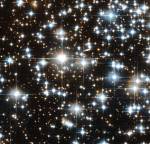 Astronomers using the Hubble Space Telescope have detected the faintest stars ever found in a globular cluster, a discovery that helps refine the age of the cluster as well as the minimum mass needed for a star to exist. Hubble observations of NGC 6397, a globular cluster 8,500 light-years from the Earth, turned up white dwarfs so faint their light was equivalent to a birthday candle on the Moon as seen from the Earth. The discovery of those stars allowed astronomers to calculate the age of the cluster at approximately 12 billion years. The observations also appeared to confirm models of stellar formation that set a minimum mass on stars of about 80 Jupiter masses: even the dimmest stars seen in the Hubble images have masses greater than this limit.
Astronomers using the Hubble Space Telescope have detected the faintest stars ever found in a globular cluster, a discovery that helps refine the age of the cluster as well as the minimum mass needed for a star to exist. Hubble observations of NGC 6397, a globular cluster 8,500 light-years from the Earth, turned up white dwarfs so faint their light was equivalent to a birthday candle on the Moon as seen from the Earth. The discovery of those stars allowed astronomers to calculate the age of the cluster at approximately 12 billion years. The observations also appeared to confirm models of stellar formation that set a minimum mass on stars of about 80 Jupiter masses: even the dimmest stars seen in the Hubble images have masses greater than this limit.
Related Links:
| <<previous article | next article>> |
|
news in brief
|
|
|
|
news links
|
|
Wednesday, September 16
Russia’s Starlink Rival “Rassvet” Fails to Reach Target Orbit 6 Months After Launch
United24 Media — 1:10 am ET (0510 GMT) Newly proposed U.S. Space Academy belongs in Huntsville, Alabama lawmakers say
Huntsville Times — 1:09 am ET (0509 GMT) North Alabama leaders pitch Huntsville to Space Command personnel at transition seminar
WAFF-TV — 1:08 am ET (0508 GMT) Air Force secretary admits US weapons are stationed in outer space
Washington Examiner — 1:06 am ET (0506 GMT) Budget impasse imperils 1 in 10 Space Force programs, new chief says
Breaking Defense — 1:04 am ET (0504 GMT) |
