NASA releases images from DS1 comet flyby
Posted: Tue, Sep 25, 2001, 5:39 PM ET (2139 GMT)
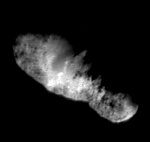 Images taken by NASA's Deep Space 1 (DS1) spacecraft during its flyby of the comet Borrelly Saturday are the best view yet of the nucleus of a comet, scientists said Tuesday. NASA released images and solar wind data collected by DS1 as it passed 2,200 km from the nucleus of Borrelly. The images, better than those taken of Halley by ESA's Giotto spacecraft in 1986, show that the nucleus is shaped roughly like a bowling pin, 8 km long and up to 4 km in diameter. The images also show widely varying terrain on the comet, including several "bright" patches (actually as dark as soot) from which powerful jets of gas and dust emanate. Solar wind data provided by DS1's ion and electron spectrometer also show that unlike other comets, Borrelly's nucleus is not in the center of the coma of gas and dust that surround it, but is rather off to one side, a possible effect of the jets seen by DS1's camera. The data provided by DS1, which will be analyzed for months to come, should aid in the planning of the five cometary encounters planned by other spacecraft in the coming decade. The flyby was hailed as a major success by NASA, noting the various problems DS1 had experienced in the past, as well as the fact that the spacecraft was primarily designed to test new technologies, with science a secondary concern. "It was the little spacecraft that could, and did," said project manager Marc Rayman.
Images taken by NASA's Deep Space 1 (DS1) spacecraft during its flyby of the comet Borrelly Saturday are the best view yet of the nucleus of a comet, scientists said Tuesday. NASA released images and solar wind data collected by DS1 as it passed 2,200 km from the nucleus of Borrelly. The images, better than those taken of Halley by ESA's Giotto spacecraft in 1986, show that the nucleus is shaped roughly like a bowling pin, 8 km long and up to 4 km in diameter. The images also show widely varying terrain on the comet, including several "bright" patches (actually as dark as soot) from which powerful jets of gas and dust emanate. Solar wind data provided by DS1's ion and electron spectrometer also show that unlike other comets, Borrelly's nucleus is not in the center of the coma of gas and dust that surround it, but is rather off to one side, a possible effect of the jets seen by DS1's camera. The data provided by DS1, which will be analyzed for months to come, should aid in the planning of the five cometary encounters planned by other spacecraft in the coming decade. The flyby was hailed as a major success by NASA, noting the various problems DS1 had experienced in the past, as well as the fact that the spacecraft was primarily designed to test new technologies, with science a secondary concern. "It was the little spacecraft that could, and did," said project manager Marc Rayman.
Related Links:
| <<previous article | next article>> |
|
news in brief
|
|
NASA IG cites overconfidence and unrealistic schedules for Starliner woes
Posted: Sat, Jul 4 8:11 PM ET (0011 GMT) |
|
news links
|
|
Thursday, July 9
Blue Origin Nears a Big Fund-Raising Round
New York Times — 4:11 am ET (0811 GMT) Bezos’ Blue Origin valued at $130 billion in first outside fundraising round
CNBC — 4:11 am ET (0811 GMT) Blue Origin reportedly raising $10B at $130B valuation
TechCrunch — 4:10 am ET (0810 GMT) Jeff Bezos' Blue Origin is raising $10 billion. Read the memo.
Business Insider — 4:09 am ET (0809 GMT) NASA should remember how it helped SpaceX become what it is today
The Hill — 4:07 am ET (0807 GMT) |
