Lack of moon orbiting Sedna puzzles astronomers
Posted: Wed, Apr 14, 2004, 11:47 PM ET (0347 GMT)
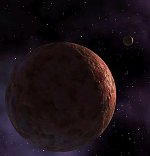 Hubble observations of the newly-discovered planetoid Sedna have failed to turn up any evidence of a moon, leaving scientists to wonder why the distant object rotates so slowly. Images of Sedna, taken by Hubble shortly after its discovery was announced last month, failed to discover a moon that astronomers had thought was orbiting the large planetoid. Astronomers had thought that Sedna had a moon based on evidence that the planetoid was rotating so slowly, with an estimated period of about 20 or 40 days, far slower than any other solar system object other than Mercury and Venus. That slow rotation could be explained if Sedna was tidally locked with a moon, but is difficult to explain otherwise. Astronomers did note that there is a small chance that any moon was hidden from Hubble's view by being directly in front of Sedna or directly behind it. Sedna, officially still known 2003 VB12, is the most distant solar system body yet known, currently about 13 billion kilometers from the Earth. It is believed to be as large as 1600 km in diameter, about three-quarters the size of Pluto.
Hubble observations of the newly-discovered planetoid Sedna have failed to turn up any evidence of a moon, leaving scientists to wonder why the distant object rotates so slowly. Images of Sedna, taken by Hubble shortly after its discovery was announced last month, failed to discover a moon that astronomers had thought was orbiting the large planetoid. Astronomers had thought that Sedna had a moon based on evidence that the planetoid was rotating so slowly, with an estimated period of about 20 or 40 days, far slower than any other solar system object other than Mercury and Venus. That slow rotation could be explained if Sedna was tidally locked with a moon, but is difficult to explain otherwise. Astronomers did note that there is a small chance that any moon was hidden from Hubble's view by being directly in front of Sedna or directly behind it. Sedna, officially still known 2003 VB12, is the most distant solar system body yet known, currently about 13 billion kilometers from the Earth. It is believed to be as large as 1600 km in diameter, about three-quarters the size of Pluto.
Related Links:
| <<previous article | next article>> |
|
news in brief
|
|
Blue Origin describes plans for increased New Glenn launch rates
Posted: Sat, Oct 17 11:41 AM ET (1541 GMT) |
|
news links
|
|
Wednesday, October 21
Lunar Link complete and ready for a new adventure
ESA — 6:58 am ET (1058 GMT) ‘European Starlink’ to be rolled out across Arctic
The Daily Telegraph — 6:57 am ET (1057 GMT) NASA administrator, Space Force General, talk Artemis and Golden Dome during UND visit
Univ. of North Dakota — 6:50 am ET (1050 GMT) Space Force aims to beef up guardian presence for Centcom and other combatant commands
Defensescoop — 6:50 am ET (1050 GMT) Iridium Announces Third Quarter 2026 Results
PR Newswire — 6:48 am ET (1048 GMT) |
